
When Love Runs Out of Life Jackets
by Michele Husfelt
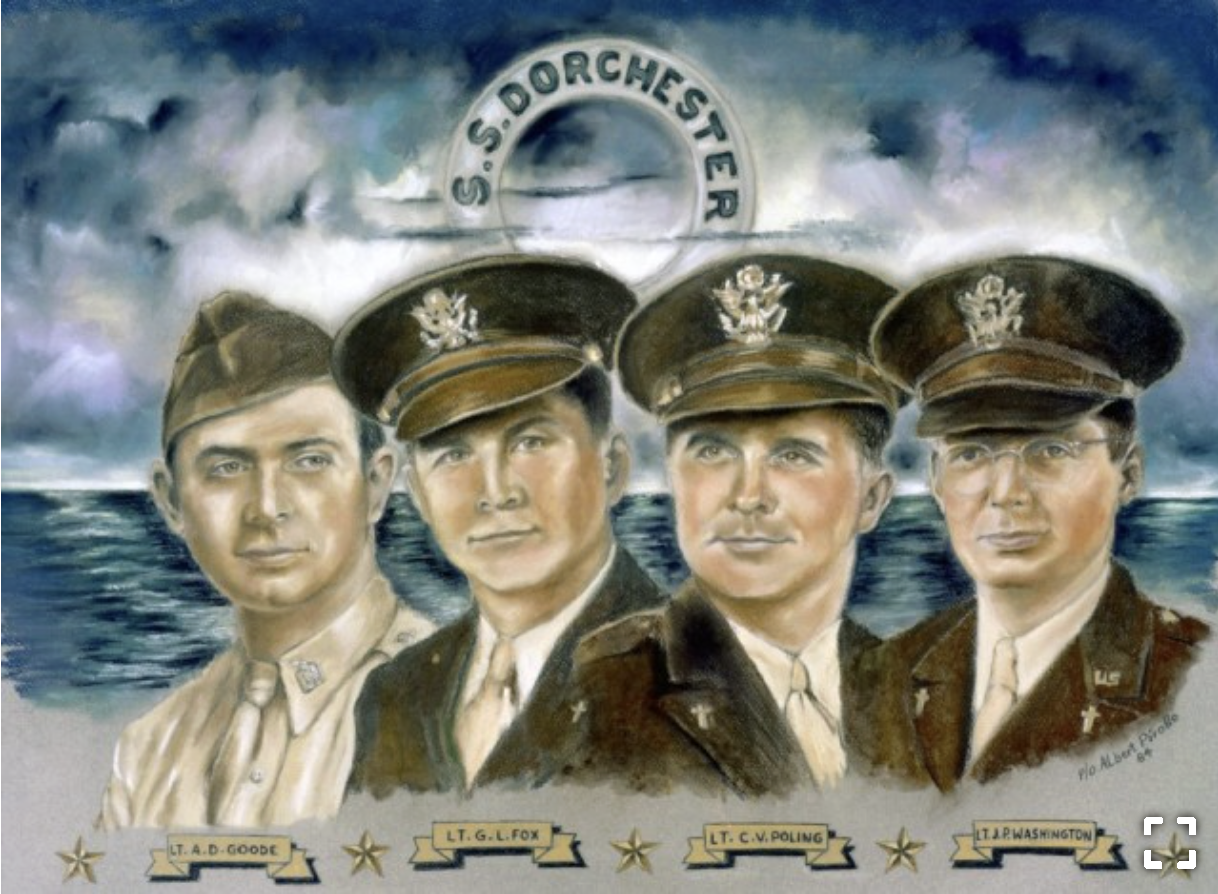
Yesterday, our local American Legion hosted a Four Chaplains Day service to commemorate the heroic actions of four military chaplains during World War II.
In the early hours of February 3, 1943, the troop ship SS Dorchester was struck by a German U-boat in the freezing North Atlantic. Chaos followed. The ship was sinking fast. Men scrambled in the dark, surrounded by icy water and fear. There weren’t enough life jackets.
Among those men were four military chaplains: George Fox, a Methodist minister; Alexander Goode, a Jewish rabbi; John Washington, a Catholic priest; and Clark Poling, a Dutch Reformed minister. Different traditions. Different prayers. Different ways of understanding God. But in that moment, those differences faded into the background.
As they passed out life jackets, the supply ran out. And when it did, these four men made a choice that still echoes eighty-three years later. They took off their own life jackets and gave them to others still waiting in line.
Eyewitnesses later recalled seeing the chaplains link arms, pray, and sing hymns as the ship went down. Out of more than 900 men aboard, only 230 survived. The chaplains were not among them.
It’s impossible not to hear the words of Jesus in that story: “Greater love has no one than this, that someone lay down his life for his friends.” Their sacrifice wasn’t planned or dramatic. It was practical. Immediate. Costly. It was love showing up when it mattered most.
What strikes me is that their faith didn’t suddenly appear in the crisis. It had been forming them long before that night. In the worst possible moment, they simply lived out who they already were. When fear screamed, “Save yourself,” love whispered, “Give what you have.”
And then there’s the other quiet miracle in this story: they did it together.
A rabbi. A priest. Two Protestant ministers. They didn’t debate theology on the deck of a sinking ship. They didn’t need to. Human need was right in front of them, and love became their shared language. Their unity didn’t erase their differences; it elevated their witness.
We may worry that working with people of different beliefs might water down our faith. But the Four Chaplains show us the opposite can be true. When we act with compassion, courage, and self-giving love, our faith becomes visible. Not compromised, but embodied.
The world doesn’t always listen to what we say we believe. But it never forgets how we love when the stakes are high.
Most of us will never face a moment as dramatic as theirs. But we face smaller versions every day. Moments when patience runs out. When comfort is threatened. When giving means it will actually cost us something. The question is the same: What will we do when the life jackets run out?
Will we cling tightly to what keeps us safe? Or will we trust God enough to give ourselves away for the sake of others?
The Four Chaplains remind us that sacrificial love is never wasted. Even in the darkest waters, it shines like a lighthouse, guiding others toward life, hope, and grace.